
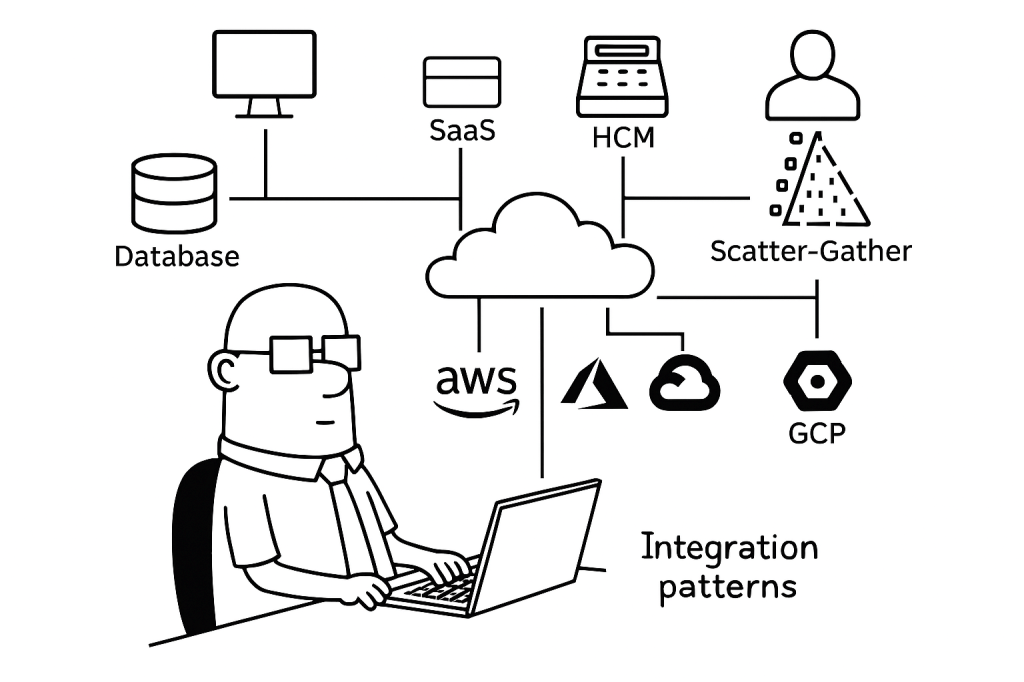
How API‑First and Event‑Driven Architectures Redefine Modern Integration
(with real‑world architecture examples)
Enterprise integration has quietly become one of the most strategic capabilities in modern organizations.
What was once labeled middleware is now a platform‑level decision that directly affects speed, resilience, and the ability to operate at scale in cloud and microservices environments.
This evolution requires rethinking Enterprise Application Integration (EAI) as a cloud‑native, API‑first, event‑driven integration platform.
Let’s ground this in how it actually looks in practice.
The Integration Problem We Keep Recreating
Most enterprises still struggle with:
- Point‑to‑point interfaces that multiply over time
- Tight coupling between systems and schemas
- Fragile integrations that slow every change
- “Modernization projects” that simply shift complexity elsewhere
As cloud, SaaS, and microservices adoption increases, these issues don’t fade—they accelerate unless integration is intentionally redesigned.
Integration Is a Platform, Not a Project
Modern enterprises that succeed treat integration as a shared platform capability, not as project‑specific plumbing.
That platform rests on three architectural pillars:
- API‑First Design
- Event‑Driven Architecture (EDA)
- Canonical Models with Governance
Real‑World Example 1: API‑First Core Commerce
Scenario: A retailer modernizes its digital channel by decoupling eCommerce from backend systems.

Architecture Pattern:
- Core systems expose business APIs (Orders, Payments, Inventory)
- APIs sit behind an API gateway with consistent security and throttling
- Front‑end channels (web, mobile, partner apps) consume APIs exclusively
Outcome:
- UI changes no longer impact backend systems
- Partners onboard faster using stable contracts
- Backend teams evolve independently
Key takeaway: API‑first turns backend systems into capability platforms, not dependencies.
APIs for Commands, Events for State
APIs handle intent. Events communicate fact.
That distinction is what enables scale.
Real‑World Example 2: Event‑Driven Order Lifecycle
Scenario: An enterprise replaces synchronous order processing chains with events.

Flow:
- OrderPlaced event published
- Inventory service subscribes and reserves stock
- Fraud service subscribes independently
- Fulfillment and analytics consume the same event
No system calls the others directly.
Outcome:
- New consumers added without changing the order service
- Failures isolated and retried asynchronously
- Near‑real‑time analytics with zero coupling
Key takeaway: Events enable parallel business evolution without coordination.
Canonical Models Still Matter (Even in Microservices)
Cloud and microservices did not eliminate the need for shared semantics.
What changed is where canonical models live.
Real‑World Example 3: Canonical Customer Model at the Boundary
Scenario: Multiple systems manage partial customer data (CRM, POS, Marketing, Support).

Approach:
- Each system keeps its internal customer representation
- At integration boundaries: APIs and events align to a canonical Customer model Transformation happens at ingress/egress
Outcome:
- One shared enterprise understanding
- No schema contagion between systems
- Easier MDM and analytics integration
Key takeaway: Canonical models provide enterprise clarity without internal rigidity.
Cloud‑Native Integration in Practice
In cloud environments, integration platforms typically include:
- Managed API gateways
- Event streaming platforms
- Workflow orchestration for long‑running processes
- Centralized observability and security
Real‑World Example 4: Cloud‑Native Supply Chain Integration
Scenario: A global manufacturer integrates suppliers, warehouses, and logistics providers.

Architecture:
- Suppliers publish shipment events
- Logistics subscribe asynchronously
- APIs expose on‑demand tracking queries
- Batch feeds coexist for legacy partners
Outcome:
- Elastic scale during peak periods
- Reduced operational overhead
- Zero redesign when new partners join
Key takeaway: Cloud absorbs integration complexity without architectural compromise.
Microservices: Integration as the Control Plane
Microservices succeed only when integration discipline is strong.
Real‑World Example 5: Saga‑Based Payments Workflow
Scenario: A payment process spans Order, Billing, Fraud, and Ledger services.

Instead of distributed transactions:
- Each service publishes events
- A saga coordinates progression
- Compensating actions reverse partial failures
Outcome:
- Independent deployments
- High resilience to partial outages
- Clear ownership boundaries
Key takeaway: Event‑driven sagas replace transactional certainty with systemic resilience.
Hybrid Reality: Modernizing Without the Big Bang
Most enterprises operate in hybrid mode—legacy plus modern.
Real‑World Example 6: Legacy System Strangulation
Scenario: A legacy ERP cannot be replaced immediately.

Approach:
- Wrap ERP with APIs and event publishers
- New systems integrate through the platform
- Point‑to‑point interfaces are retired incrementally
Outcome:
- Modernization without disruption
- Reduced risk
- Gradual extraction of core capabilities
Key takeaway: Integration enables evolution, not upheaval.
What CTOs Should Optimize For
- Loose coupling over local optimization
- Contracts over implementations
- Events over orchestration where possible
- Governance that enables autonomy
- Platforms treated as long‑lived products
Final Thought
Integration is no longer middleware.
It is:
- Architecture strategy
- Organizational leverage
- A prerequisite for digital scale
API‑first and event‑driven integration platforms don’t remove complexity—they decide where it lives.
The enterprises that scale best are not the ones with the fewest systems, but the ones with the healthiest integration architecture.
Want to Discuss This in Your Context?
I work with CTOs, Chief Architects, and senior engineering leaders to design and modernize enterprise integration architectures—from traditional EAI and ESB platforms to API‑first, event‑driven, cloud‑native ecosystems.
My focus is on:
- Translating strategy into practical reference architectures
- Reducing integration complexity without slowing delivery
- Modernizing legacy systems incrementally and safely
- Designing integration platforms that scale across teams, domains, and technologies
If you’re:
- Re‑thinking EAI or ESB as an enterprise integration platform
- Moving toward API‑first or event‑driven architecture
- Scaling microservices without fragmenting your ecosystem
- Designing a pragmatic cloud or hybrid integration strategy
I’m happy to review your current architecture, exchange perspectives, or support focused consulting or advisory engagements.
📩 Feel free to reach out or connect with me directly here on LinkedIn.
— Moustafa Refaat: MRefaat@GeneticThought.com
 Modern Tech Architecture