
I was at a networking event recently when a young software engineer cornered me with a familiar set of questions:
“Do you have certifications?
I’ve been working with AWS for three years, but I don’t have any.
Are they really necessary? How hard are they? Are they even worth it?”
That’s not one question — that’s an existential crisis disguised as curiosity.
So here’s the opinionated, no-BS version of what I told him.
For years, I thought certifications were a glorified money grab.
I’ll admit it: for the longest time, I avoided certifications like they were parking tickets.
I thought:
- “I’m already doing the work, why should I pay to prove it?”
- “I don’t need a badge to validate my skills.”
- “Cloud providers just invented exams to print money.”
And look, there’s some truth there. AWS, Azure, and Google aren’t running these exams out of the kindness of their hearts.
But here’s the uncomfortable reality:
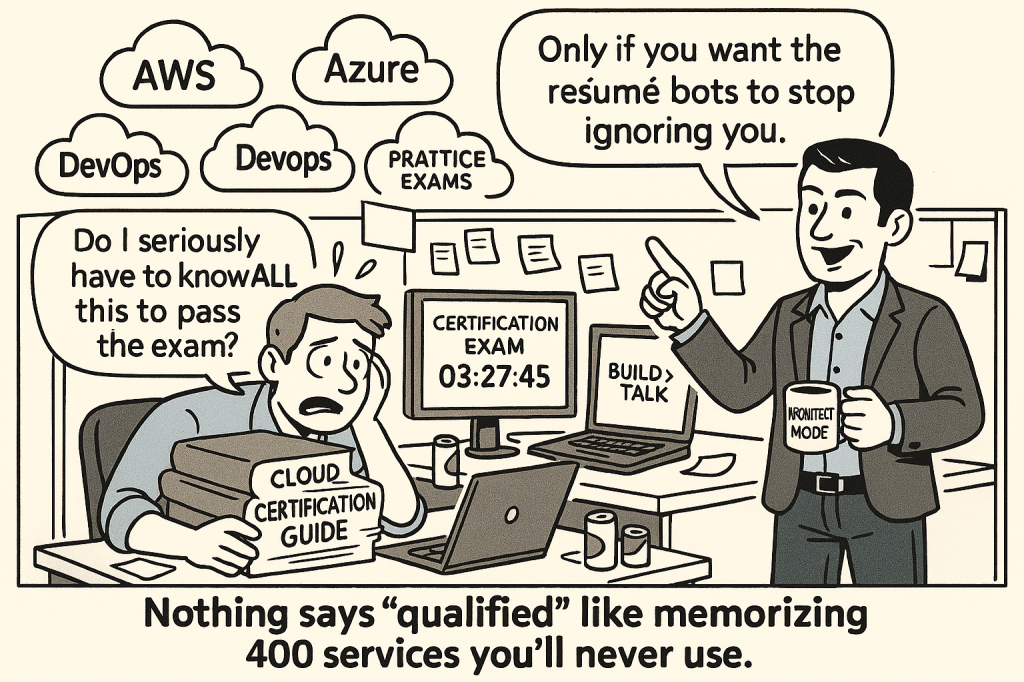
If you don’t have certifications today, your résumé might not even get scanned — by humans or by bots.
HR filters love certificates. Recruiters love certificates.
Even hiring managers who hate certificates still rely on them because it reduces risk.
Not having one doesn’t mean you aren’t competent — it just means you’re harder to hire.
So… are certifications necessary?
No.
But are they extremely useful?
Yes — especially early in your career or when pivoting roles.
Certifications don’t make you an expert.
They tell the world: “I take this field seriously enough to invest in structured learning.”
That perception matters.
How hard are cloud certifications, really?
I’d put most AWS, Azure, and GCP exams around a 5 or 6 out of 10 in difficulty.
They’re not “cry in a corner” hard, but they’re also not something you casually walk into.
Here’s what makes them tricky:
1. The sheer volume of material
You told me you’ve used AWS for three years. Great.
But you’ve probably only touched 30–40% of what AWS actually offers. [Is Certifi…n worth it | Word]
The exams expect you to know the majority of AWS services — even the weird ones that only three people in the world use on purpose.
2. The time investment
Studying takes time — reading, watching courses, doing practice exams.
Not hard, but lengthy. A certification isn’t difficult, it’s dense. [Is Certifi…n worth it | Word]
Cloud vendors love to toss 400-page whitepapers at you and whisper, “Good luck.”
3. The tricky wording of questions
The biggest threat isn’t lack of knowledge — it’s your assumptions.
Most answers are technically correct in some context.
Your real job during the exam is to decode what AWS/Azure/GCP is really asking. [Is Certifi…n worth it | Word]
Reading every question twice isn’t optional — it’s survival.
So… is it worth it?
Let me be blunt: Yes. If your goal is career growth, mobility, or landing interviews, certifications are worth every hour you invest.
But not because:
- You’ll suddenly become a better architect
- You’ll gain magical cloud enlightenment
- You’ll understand every AWS service in existence
No. You’ll get value because:
1. Certifications open doors
Like it or not, they shortcut you past gatekeepers.
2. They force structured learning
Even seasoned engineers discover blind spots they didn’t know they had.
3. They create professional momentum
Once you pass one, your confidence spikes.
Passing the next becomes easier.
4. It signals seriousness
To recruiters, you’re now someone who invests in yourself.
5. They help you switch clouds or roles
Moving from AWS to GCP?
Azure to AWS?
Dev to DevOps?
A cert is the fastest way to prove you’re not bluffing.
But here’s the part no one talks about…
Certifications don’t replace experience.
They don’t make you a senior engineer.
They don’t teach the messy, real-world problems.
But in the early- and mid-career stages, they stack the deck in your favor.
And as someone who once dismissed them as a waste of time, I’ll tell you this:
I regret not doing them earlier.
Final Verdict
If you’re thinking about AWS, Azure, or GCP certifications:
- They’re not mandatory.
- They’re not magic.
- But they are absolutely worth it for career flexibility, credibility, and opportunity.
You’re not buying a certificate — you’re buying options.
 Modern Tech Architecture